Early health-tech prototype
Oroscan
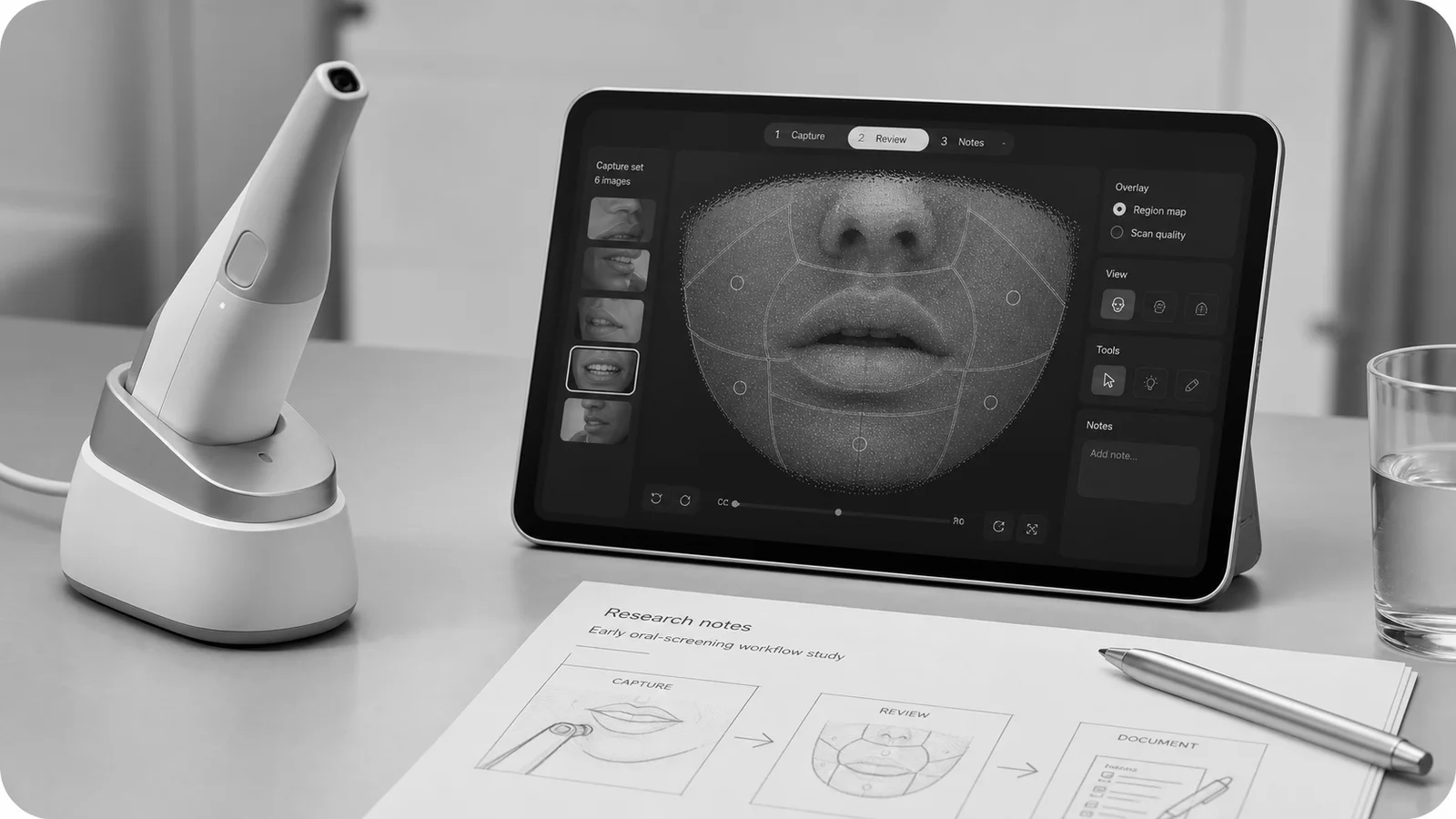
Oroscan is an early oral-screening prototype that introduced me to clinical-context constraints, careful claims, and the difference between a compelling demo and validated healthcare technology.
01 / Problem
What needed to change
Screening workflows need to be understandable, testable, and careful about uncertainty. A health-tech prototype must communicate what it can support without presenting an experimental result as a diagnosis.
02 / My role
What I personally did
I contributed as a founding member and co-developer, working on early product and prototype thinking. The most important lesson was not to overstate what a prototype proves, especially when the context is healthcare.
03 / Mechanics
How the system works
- 01An early screening-oriented workflow rather than a public diagnostic claim.
- 02Product thinking around image capture, review, and clinical context.
- 03Testing conversations used to identify workflow and communication constraints.
04 / Decisions
The product judgment
- Describe the work as a prototype and avoid clinical efficacy language.
- Separate technical possibility from medical validation.
- Treat hospital-context feedback as a learning signal, not certification.
05 / Outcomes
What exists now
- Experience designing more carefully around risk, uncertainty, and sensitive claims.
- A prototype direction connected to oral-screening workflows.
- A clearer standard for how health-tech work should be presented publicly.
06 / Sources
Proof and claim boundaries
Public links are attached directly. Private records are identified but never exposed through the site.
Founding member and co-developer of the Oroscan prototype.
Project documentation held privatelyThe Oroscan prototype was explored in a hospital-testing context; no clinical efficacy claim is made.
Testing documentation held privately